Google, Microsoft, and xAI Agree to Share Early AI Models with U.S. Government
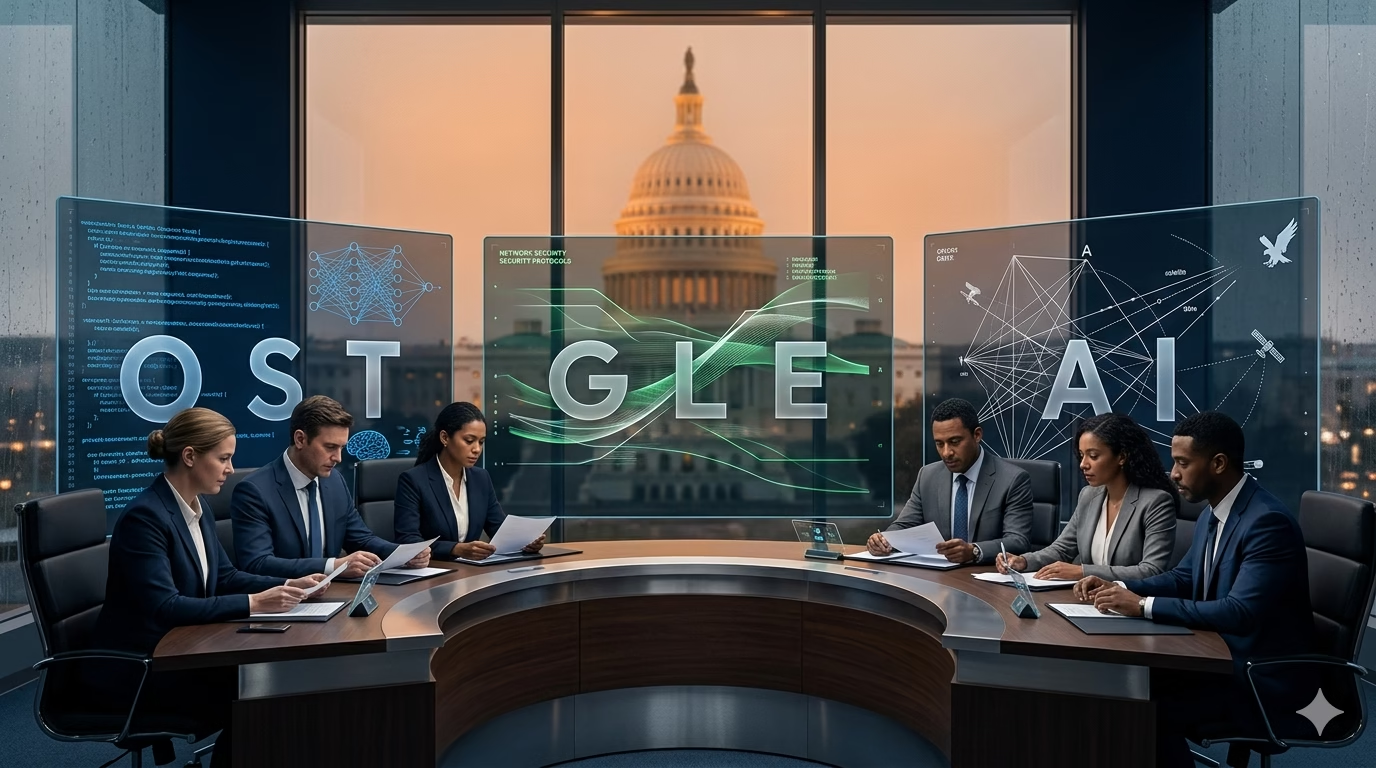
In a historic move for the technology sector, several of the world’s most powerful tech companies have entered into a landmark agreement with the United States government. As of May 5, 2026, Google, Microsoft, and xAI have formally committed to sharing their “frontier” AI models with federal authorities before they are released to the general public. This agreement is designed to ensure that the most advanced artificial intelligence systems undergo rigorous safety and national security testing.
1. The Core of the Agreement: Safety Before Release
The primary goal of this partnership is to allow federal researchers to probe advanced AI systems for potential risks. This process is managed by the Center for AI Standards and Innovation (CAISI), a specialized unit within the Department of Commerce.
- Pre-Deployment Testing: CAISI will have the authority to evaluate models before they are deployed to the public.
- Risk Assessment: Researchers will check if the AI could assist in creating cyberattacks, biological threats, or large-scale misinformation campaigns.
- Expansion of Oversight: This deal brings Google, Microsoft, and Elon Musk’s xAI into a framework that already included OpenAI and Anthropic.
- Model Vulnerabilities: The companies will provide versions of their models that allow the government to see how the system behaves when safety filters are removed.
2. Financial Context: AI Drives Massive Revenue Growth
While these companies are agreeing to more oversight, they are also seeing record-breaking financial success. Recent earnings reports show that Microsoft and Google earnings shine as AI drives revenue across their cloud and search divisions.
- Skyrocketing Demand: Microsoft and Google gain after AI fuels cloud computing demand, with businesses racing to adopt AI-powered tools.
- Alphabet (Google) Success: Google reported nearly $110 billion in revenue for Q1 2026, a 22% increase.
- Microsoft Growth: Microsoft’s revenue rose to over $82 billion, driven largely by its Azure AI services.
- Cloud Milestones: Google Cloud revenue specifically jumped 63%, crossing the $20 billion mark for the first time.
3. The Pentagon and National Security Applications
Beyond civilian safety, the Department of Defense is actively integrating these tools into military infrastructure. Microsoft AI and Google AI are now being deployed on classified networks to assist with defense operations.
- Classified Contracts: The Pentagon has reached agreements with Google, Microsoft, xAI, and OpenAI to use their frontier models in secure environments.
- Cyber Defense: Specialized models, such as OpenAI’s GPT-5.4-Cyber, are being used specifically for defensive military cybersecurity.
- Strategic Advantage: The U.S. military aims to use these models for real-time risk assessment and logistical planning.
4. Addressing the Energy and Infrastructure Crisis
The massive power required to run these AI models has become a major concern for the public and the government.
- Ratepayer Protection: Google, Microsoft, and xAI have signed a pledge to cover the electricity costs of their own data centers.
- Protecting Consumers: This ensures that residential households do not see their utility bills rise because of the high energy demand from AI.
- Power Demand: Experts estimate that the AI sector will need 50 gigawatts of new power capacity within the next few years to keep up with growth.
Frequently Asked Questions (FAQs)
1. Why are these companies sharing their models with the government?
The agreement is meant to prevent “frontier” AI models from being used for harm. By sharing them early, the government can identify if a model is capable of helping someone build a weapon or launch a massive cyberattack before the public can access it.
2. Is xAI part of this agreement too?
Yes. Elon Musk’s xAI has joined Google and Microsoft in this commitment. This is significant because it shows that even independent “challenger” AI companies are agreeing to federal safety standards.
3. How much money are these companies making from AI?
In early 2026, the financial impact is enormous. Google Cloud revenue grew by 63%, and Microsoft’s AI revenue run rate has surpassed $37 billion annually, showing that AI is now the primary driver of their stock gains.
4. What is “CAISI”?
CAISI stands for the Center for AI Standards and Innovation. It is the government body responsible for testing these AI models for safety and ensuring they meet national security requirements.
5. Will this agreement make AI safer for regular users?
Ideally, yes. By catching “catastrophic” risks at the government level, the companies can build better guardrails into the versions of the AI that regular people use in their daily lives
📩 Start Growing Your Digital Presence Today
Partner with RojrzTech to craft digital experiences designed for long-term success and real audience connection. Let’s build an online presence that works harder for your business