Google Meet Launches an AI-Powered Makeup Feature: The Future of Video Presence
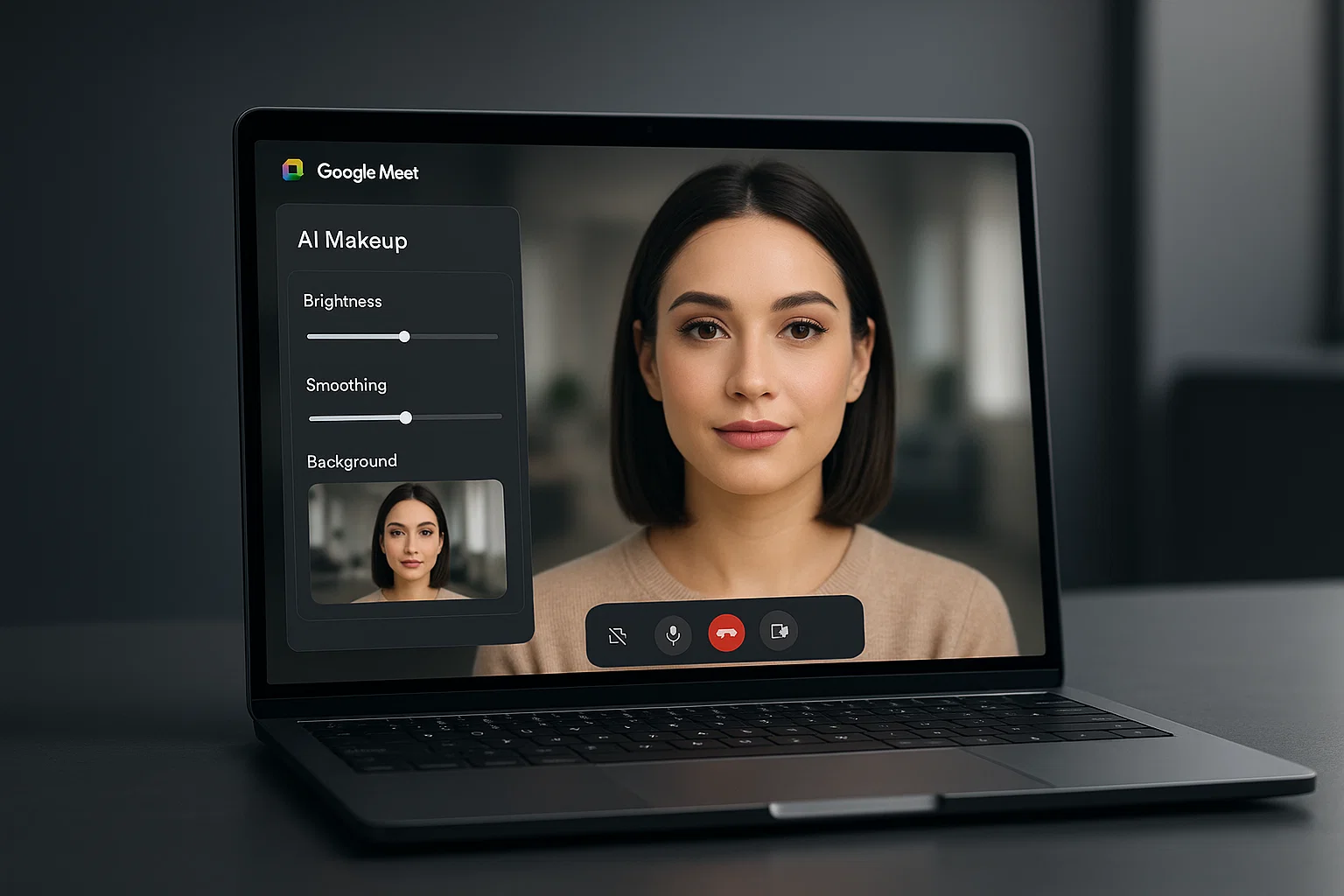
Artificial intelligence is rewriting the way humans connect, communicate, and now — even how they appear. Google has officially launched its latest innovation, an AI-powered makeup feature in Google Meet, designed to give users a clean, natural look during video calls. This update takes the concept of digital presence to an entirely new level, powered by smart design and deep-learning algorithms.
AI Meets Human Expression
The new Google Meet AI update brings together beauty technology and advanced neural rendering. The feature detects facial landmarks in real time, enhances texture, adjusts lighting, and applies virtual makeup effects — all without distorting natural features. The result is not an artificial filter but an adaptive visual layer that enhances your real appearance.
Google’s engineers describe this as a step toward AI-human harmony — where technology doesn’t alter identity but enhances how it is perceived on screen.

Behind the Technology
This feature runs on Google’s TensorFlow-based AI models optimized for real-time performance. It captures micro expressions, shadow patterns, and ambient light through the webcam feed, applying instant corrections that adapt dynamically.
Unlike typical “beauty filters,” Google’s virtual makeup system is trained on inclusive datasets, recognizing diverse skin tones, facial geometries, and lighting environments. The focus is precision and authenticity — not unrealistic perfection.
The AI face mapping engine uses over 300 data points to analyze how light interacts with each region of the face. It then adjusts parameters like tone, brightness, and color temperature to maintain consistency throughout the call.
Designed for Everyday Professionals
The update isn’t limited to influencers or creative users. It’s built for everyone — from corporate professionals attending meetings in dim lighting to teachers hosting online classes.
With a single click, users can choose between different presets like “Subtle Enhancement,” “Studio Light,” or “Natural Glow.” Each preset represents a blend of AI adjustments that work intelligently with individual facial profiles.
This feature is also lightweight. It doesn’t require external plugins or third-party apps — it’s fully embedded into Google Meet’s core design.
Real-Time Enhancement, Zero Lag
Performance optimization is a major highlight of this release. Using edge-based AI computation, the system reduces latency by processing most visual data locally rather than sending it to cloud servers. This means real-time face enhancement with minimal resource load, preserving both bandwidth and privacy.
Even on low-end devices, users experience seamless rendering because of Google’s adaptive frame-rate adjustment. The technology ensures the effect remains stable even under unstable network conditions.
Privacy and User Control
In an era where digital privacy defines trust, Google assures users that this AI beauty filter runs completely client-side. No image data or facial mapping information is stored or transmitted to external servers. Users retain full control, with the ability to turn off the feature anytime.
This privacy-centric approach separates Google’s solution from other AI camera tools, where user data is often uploaded and analyzed remotely. The company’s focus remains on ethical AI — intelligent systems that serve without surveillance.
A Strategic Move in AI-Powered Design
Industry experts view this update as part of Google’s broader strategy to integrate AI-driven personalization across its ecosystem. From Gemini-powered tools to smart presentation features in Workspace, the company is moving toward an interconnected future where every product adapts to user needs automatically.
By merging AI with design thinking, Google is reinforcing its leadership in human-centered technology. The virtual makeup technology is not just about beauty — it’s about creating inclusive digital environments where everyone feels confident on camera.
The Bigger Picture: AI in Communication
This launch aligns with a growing trend across tech industries — AI in video conferencing. As remote work and digital collaboration become permanent fixtures, companies are investing in technologies that improve not just sound and image quality, but emotional comfort too.
Virtual reality (VR), augmented reality (AR), and now AI-powered facial enhancement are redefining what “presence” means online. Google’s innovation indicates that the future of communication will be intelligent, adaptive, and deeply personal.
Industry Impact and Future Outlook
With this release, Google sets a new benchmark for digital self-expression. Competing platforms like Zoom and Microsoft Teams may soon follow suit with their own AI camera effects, accelerating the evolution of the online communication ecosystem.
Experts predict that within the next few years, AI video filters will move beyond makeup and lighting — adapting to clothing color palettes, mood tones, and even environmental context. These systems will merge aesthetic design with psychological intelligence, helping users express themselves confidently in every digital scenario.
Final Words
Google’s AI-powered makeup feature is more than a convenience tool. It’s a symbol of how AI is reshaping identity in digital spaces. By balancing intelligence with ethics, Google is building a future where innovation serves authenticity — and where virtual interactions feel as human as real ones.
For RojrzTech readers, this launch marks another significant moment in the evolution of AI design systems — a future where your camera understands you better than ever before.