New AI Breakthrough May Bring Full FSD V14 to Tesla’s HW3 Vehicles
Introduction
A new artificial intelligence breakthrough could significantly extend the life and capabilities of older Tesla vehicles. Reports suggest that Full Self-Driving (FSD) V14 may soon become available for Tesla cars equipped with HW3 hardware, thanks to major advancements in AI optimization and neural network efficiency.
This development has sparked excitement across the automotive and tech industries, especially among Tesla owners who previously believed that the latest features would remain exclusive to newer hardware generations like HW4. If successful, this breakthrough could reshape expectations around software scalability and hardware longevity in autonomous driving.
Understanding Tesla’s FSD Evolution
Tesla’s Full Self-Driving system has evolved rapidly over the years. From early driver-assist features to more advanced AI-driven autonomy, each version has brought improvements in safety, perception, and decision-making.
- FSD V12 introduced end-to-end AI models, reducing reliance on hand-coded rules
- FSD V13 (expected) focuses on further refining real-world driving intelligence
- FSD V14 is expected to push the boundaries even further with improved reasoning and adaptability
Earlier discussions around Tesla AI Day 2022 FSD highlighted the company’s shift toward neural networks trained on massive datasets. These innovations laid the foundation for today’s breakthroughs.
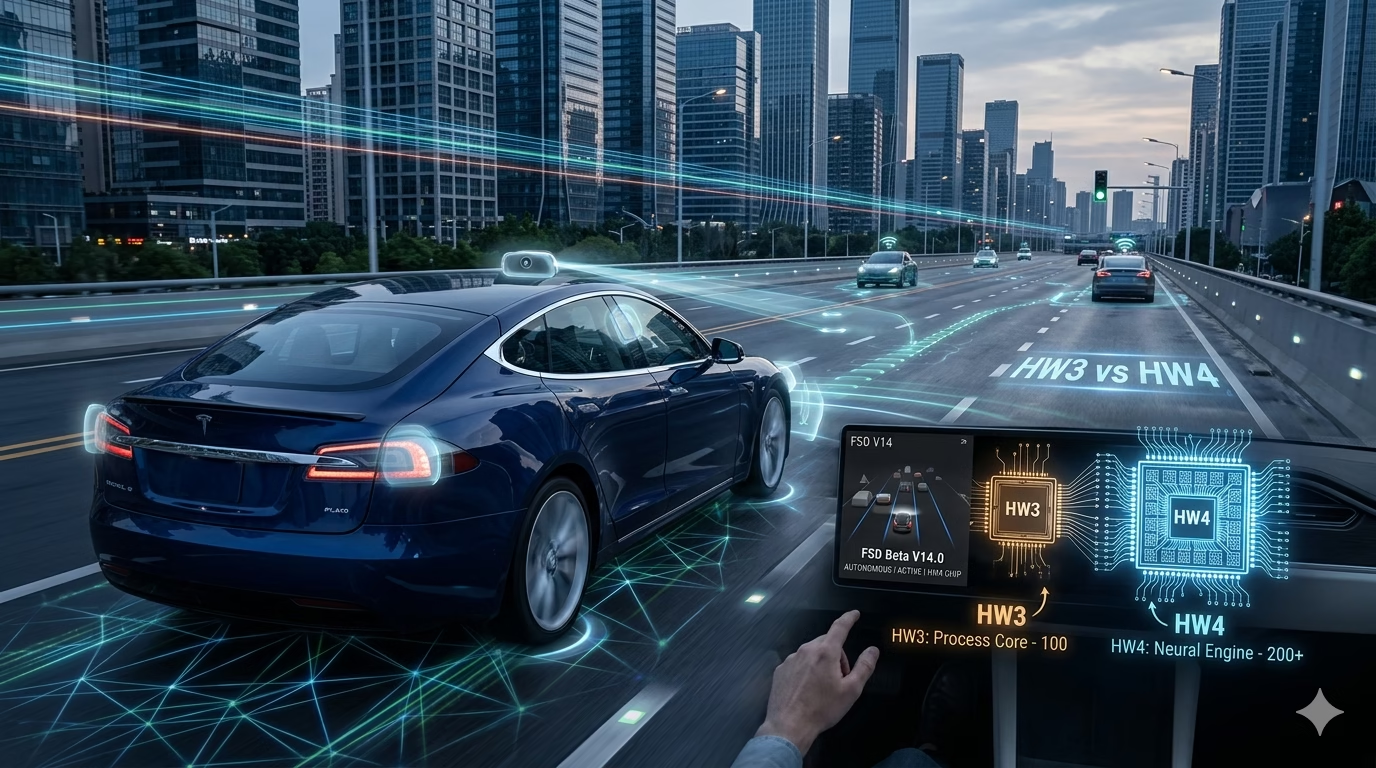
HW3 vs HW4: What’s the Difference?
Tesla’s hardware plays a crucial role in enabling autonomous driving features.
HW3 (Hardware 3.0)
- Introduced around 2019
- Custom AI chip designed by Tesla
- Capable of running advanced neural networks
- Installed in millions of Tesla vehicles globally
HW4 (Hardware 4.0)
- Newer and more powerful AI chip
- Higher processing capability
- Improved camera systems and sensors
- Designed for next-generation FSD performance
Until recently, it was widely believed that future updates like FSD V14 would require the Tesla HW4 FSD chip. However, the latest AI breakthrough challenges this assumption.
The AI Breakthrough Explained
The key innovation lies in optimizing neural networks to run more efficiently on existing hardware. Instead of requiring more powerful chips, Tesla’s AI team appears to be focusing on:
- Model compression to reduce computational load
- Improved training techniques for better performance with fewer resources
- Smarter data utilization to enhance real-world driving decisions
This means that even older HW3 systems could potentially handle advanced FSD features without needing a hardware upgrade.
Such efficiency improvements are not just technical achievements—they are strategic moves that could allow Tesla to deliver cutting-edge features to a much larger user base.
Tesla AI Day and Its Role in Innovation
The groundwork for this breakthrough can be traced back to Tesla AI Day 2022, where Tesla showcased its advancements in AI, neural networks, and autonomous driving.
Key highlights included:
- Development of large-scale neural networks
- Use of real-world driving data for training
- Introduction of Dojo supercomputer for AI training
The Tesla AI Day presentation PDF and Tesla AI Day 2022 PPT emphasized the importance of scaling AI efficiently—a vision that now appears to be materializing with this latest breakthrough.
Global Perspective: FSD V12 and China
Tesla’s progress with FSD V12 China also plays an important role in shaping future updates. China presents a complex driving environment with:
- Dense traffic conditions
- Unique road rules
- High variability in driving behavior
Success in such markets demonstrates the robustness of Tesla’s AI systems. If FSD performs well in China, it strengthens the case for deploying advanced versions like V14 globally—even on older hardware.
Tesla Technology 2024 and Beyond
Tesla’s innovations are not limited to software alone. The company continues to push forward in areas like:
- AI hardware development
- Autonomous driving algorithms
- Data collection and processing
- Vehicle-to-cloud integration
The phrase Tesla technology 2024 represents a broader shift toward AI-driven mobility. With each update, Tesla is moving closer to achieving fully autonomous driving.
The possibility of bringing FSD V14 to HW3 vehicles shows how Tesla is prioritizing scalability and user experience alongside innovation.
Safety and “Tesla Hadsa” Concerns
Despite these advancements, safety remains a critical concern. Reports of accidents, often referred to as Tesla hadsa, continue to raise questions about the readiness of autonomous systems.
Key concerns include:
- Over-reliance on automation by drivers
- Misinterpretation of road conditions
- Edge-case scenarios where AI struggles
Tesla has consistently emphasized that FSD is a driver-assistance system and requires active supervision. Future updates like V14 are expected to improve safety, but they will also need to address public concerns and regulatory scrutiny.
What This Means for Tesla Owners
If FSD V14 becomes available for HW3 vehicles, it would be a major win for Tesla owners.
Benefits:
- No need for expensive hardware upgrades
- Access to latest autonomous features
- Increased resale value of older vehicles
Challenges:
- Performance limitations compared to HW4
- Possible feature restrictions
- Gradual rollout depending on region
This move could also strengthen Tesla’s reputation for supporting older vehicles, something that sets it apart from many competitors.
Industry Impact
This breakthrough could have a ripple effect across the automotive industry.
- Competitors may need to rethink hardware upgrade strategies
- AI optimization could become a key focus area
- Consumers may demand longer software support cycles
Tesla’s approach demonstrates that innovation is not just about building new hardware, but also about maximizing the potential of existing systems.
Conclusion
The possibility of bringing FSD V14 to HW3 vehicles marks a significant milestone in Tesla’s journey toward full autonomy. By leveraging AI breakthroughs and optimizing neural networks, Tesla may be able to deliver next-generation features without requiring new hardware.
This development highlights the power of software-driven innovation and reinforces Tesla’s position as a leader in autonomous driving technology. However, challenges related to safety, regulation, and real-world performance remain.
As Tesla continues to refine its AI systems, the dream of fully autonomous driving is becoming increasingly realistic—not just for new vehicles, but for millions of cars already on the road.
FAQs
1. What is FSD V14?
FSD V14 is an upcoming version of Tesla’s Full Self-Driving software expected to include more advanced AI capabilities and improved driving intelligence.
2. Can HW3 vehicles support FSD V14?
Recent AI breakthroughs suggest that HW3 vehicles may be able to run FSD V14 through optimized neural networks.
3. What is the difference between HW3 and HW4?
HW4 is more powerful with better processing and sensors, while HW3 is older but still capable of running advanced AI systems.
4. What was announced at Tesla AI Day 2022?
Tesla showcased advancements in AI, neural networks, and autonomous driving technologies, including large-scale training systems.
🚀Build a Stronger Digital Footprint with RojrzTech
In a constantly changing digital environment, brands succeed by staying flexible and focused. RojrzTech delivers tailored solutions across web development, UI/UX, SEO, branding, and social media to help businesses strengthen visibility and performance online.
📩 Start Your Digital Growth Journey
Connect with RojrzTech to create digital experiences that support long-term growth and meaningful engagement. Let’s shape a smarter, more impactful online presence