
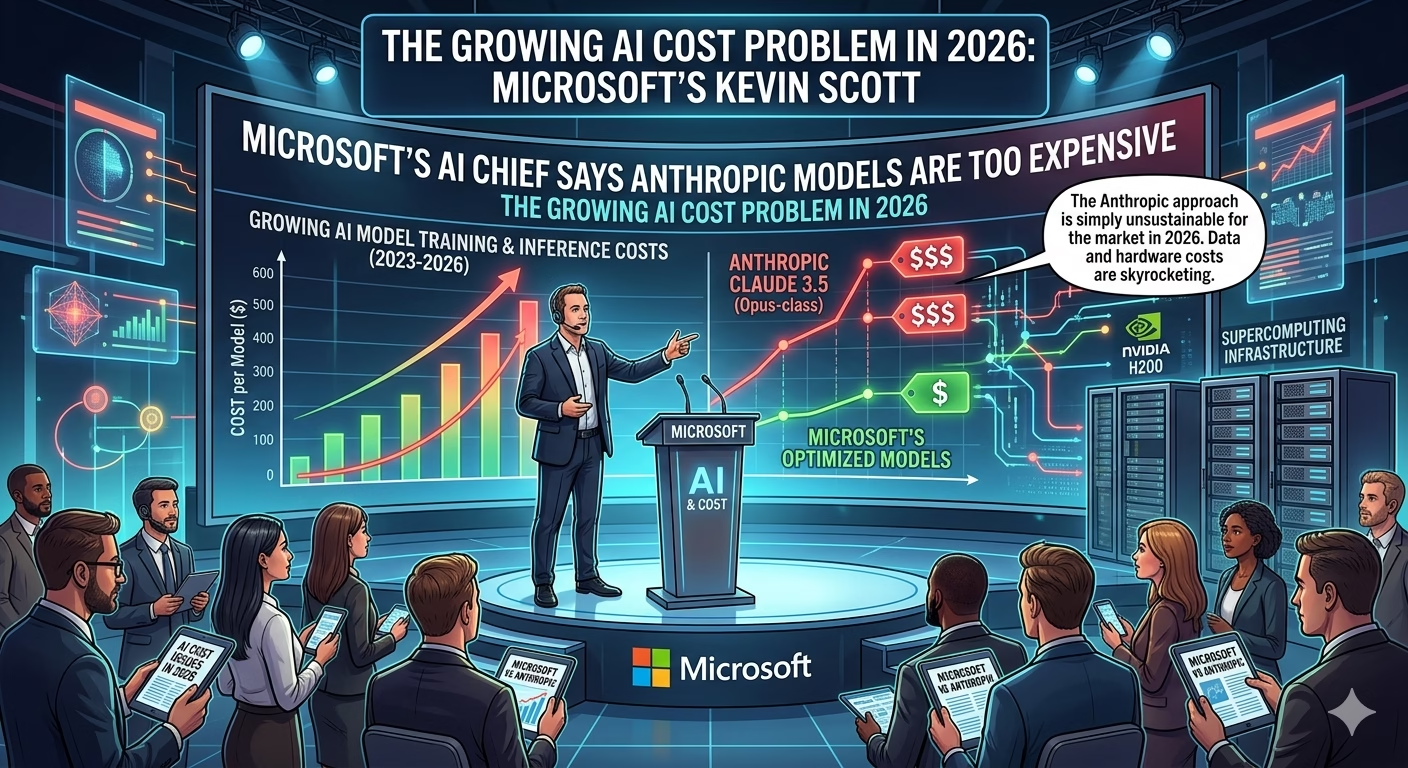
Microsoft’s AI Chief Says Anthropic Models Are Too Expensive: What It Means for the Future of Enterprise AI
The artificial intelligence industry has entered a new phase. For the last few years, the focus was largely on building increasingly powerful AI models. Companies competed to release smarter chatbots, stronger reasoning systems, and more capable coding assistants. Now, however, another challenge is taking center stage: cost.
Recent comments from Microsoft AI CEO Mustafa Suleyman have sparked widespread discussion across the technology sector. Suleyman stated that Anthropic’s AI models are “extremely expensive” and suggested that Microsoft aims to reduce and eventually eliminate what it pays Anthropic for AI services. The remarks highlight a growing concern among enterprises that the cost of advanced AI systems may be rising faster than the value they deliver.
This development is significant because it reflects a broader industry trend. Businesses are no longer evaluating AI solely on performance. Instead, they are asking a critical question: Is the productivity gain worth the cost?
Microsoft’s Growing AI Cost Concerns
Microsoft has invested billions into artificial intelligence over the past several years. Through products such as GitHub Copilot, Microsoft 365 Copilot, Azure AI services, and numerous internal AI initiatives, the company has become one of the biggest consumers of AI computing resources in the world.
According to reports, Mustafa Suleyman believes many organizations are actively seeking alternatives because Anthropic’s models have become too costly for large-scale deployment. He emphasized that Microsoft spends substantial amounts on Anthropic technology and wants to reduce those expenses through internally developed AI models.
This statement is important because Microsoft is not a casual AI customer. The company operates some of the world’s largest AI infrastructures. If Microsoft is worried about costs, many smaller enterprises are likely facing the same challenge.
The issue is not simply subscription pricing. Modern AI systems consume enormous computational resources. Every query, code generation task, image creation request, or agent-based workflow requires processing power, memory, and infrastructure. These expenses accumulate rapidly when AI is deployed across thousands of employees.
The Rise of the AI Cost Problem
The AI industry often focuses on model capabilities, benchmark scores, and new features. However, real-world deployment introduces economic realities.
Reports throughout 2026 suggest that several major companies have experienced unexpectedly high AI spending. Some organizations found that widespread employee usage caused budgets to be exhausted far earlier than expected. In certain cases, businesses discovered that AI-generated work was costing more than anticipated while producing uncertain productivity gains.
This emerging challenge has become known as the AI cost problem.
The issue is especially visible in coding tools. AI coding assistants can generate thousands of lines of code, review projects, identify bugs, and automate development tasks. While these capabilities are impressive, they also consume significant computing resources. As usage scales, operational expenses can become difficult to manage.
Organizations are now measuring not only how much AI can do but also how much it costs to achieve those results.
Why Anthropic’s Models Are Considered Expensive
Anthropic has earned a strong reputation for building high-performance AI systems, particularly in coding and reasoning tasks. Claude models are widely respected among developers and enterprises because of their advanced capabilities and reliability.
However, cutting-edge performance often comes at a price.
Large language models require enormous computational resources for both training and inference. Advanced reasoning models process more tokens, perform deeper analysis, and use greater amounts of computing power. These factors increase operational costs.
As organizations deploy AI assistants to thousands of workers, token consumption can grow exponentially. Businesses may discover that what seemed affordable during pilot programs becomes extremely expensive at enterprise scale.
This challenge is particularly relevant for coding assistants such as Claude Code, where users may generate massive volumes of code and repeatedly interact with AI systems throughout the workday. Reports indicate that Microsoft plans to transition many internal users toward GitHub Copilot CLI as part of efforts to streamline costs and consolidate tooling.
Microsoft’s Response: Building In-House Alternatives
Rather than relying heavily on external AI providers, Microsoft is increasingly investing in its own AI models.
At Build 2026, Microsoft introduced several new in-house models designed for reasoning, coding, transcription, image processing, and enterprise applications. These models are intended to reduce dependence on third-party providers while improving cost efficiency.
The strategy is straightforward.
If Microsoft can create AI models that deliver comparable performance at lower cost, it can:
- Improve profit margins.
- Reduce external vendor dependence.
- Offer more competitive AI services.
- Scale AI products more efficiently.
- Control future infrastructure expenses.
This approach mirrors trends seen throughout the technology industry, where companies often build proprietary solutions after initially relying on external providers.
The Claude Code Debate
One of the most discussed topics in recent months has been Claude Code.
Anthropic’s coding assistant has developed a loyal following among developers because of its ability to understand large codebases, solve complex programming problems, and generate production-ready code. Many engineers consider it one of the strongest AI coding tools currently available.
However, popularity can create a new challenge.
The more employees use an AI tool, the more tokens are consumed. Since many AI providers charge based on usage, widespread adoption can cause costs to rise dramatically.
Reports indicate that Microsoft’s decision to reduce Claude Code usage internally was influenced partly by cost considerations and the desire to promote GitHub Copilot CLI. Importantly, this does not necessarily mean Claude Code lacks value. Instead, it reflects the ongoing struggle to balance performance with affordability.
Enterprise AI Is Entering a New Phase
The first phase of AI competition focused on capability.
The second phase appears to be focused on economics.
Companies are now asking:
- Which model provides the best value?
- Which platform offers sustainable costs?
- How can AI usage be controlled at scale?
- What productivity gains justify AI spending?
These questions are becoming increasingly important as AI deployments expand across enterprises.
The future winners may not simply be the companies with the smartest models. They may be the companies that deliver the best balance between performance and cost.
What This Means for the AI Industry
Microsoft’s comments could have major implications for the broader AI ecosystem.
First, they increase pressure on AI providers to improve efficiency. Customers want powerful models, but they also need predictable pricing.
Second, they encourage greater competition. If organizations believe current AI solutions are too expensive, demand for alternative models will grow.
Third, they highlight the importance of infrastructure optimization. AI companies must continuously improve hardware utilization, model architecture, and inference efficiency to remain competitive.
Finally, they reinforce the idea that AI adoption is ultimately a business decision. Even groundbreaking technology must demonstrate economic value.
Looking Ahead
Artificial intelligence remains one of the most transformative technologies of the modern era. However, the conversation is evolving.
Instead of asking whether AI works, companies are asking whether AI is financially sustainable.
Microsoft’s criticism of Anthropic’s pricing reflects this shift. Organizations increasingly want AI solutions that combine strong performance with manageable costs.
Anthropic remains a leader in advanced AI capabilities, particularly in coding and reasoning applications. Yet Microsoft’s investment in internal AI models demonstrates that enterprises are actively searching for ways to reduce dependence on expensive external systems.
The next chapter of the AI race may not be won by the company with the most powerful model. It may be won by the company that delivers the best performance per dollar.
As businesses continue expanding AI usage across their operations, cost efficiency will likely become one of the most important competitive factors shaping the future of artificial intelligence.
FAQs
Why did Microsoft say Anthropic models are too expensive?
Microsoft AI CEO Mustafa Suleyman stated that Anthropic’s models are extremely expensive and that Microsoft aims to reduce and eventually eliminate those costs through its own AI technologies.
Is Microsoft banning Anthropic AI?
No. Reports suggest Microsoft is reducing internal reliance on Claude Code and encouraging use of GitHub Copilot CLI, but Anthropic models remain available through various Microsoft-related services.
What is Claude Code?
Claude Code is Anthropic’s AI-powered coding assistant designed to help developers write, review, and manage software projects through natural language interactions.
Why are enterprise AI costs rising?
Enterprise AI costs are increasing due to growing token consumption, expensive computing infrastructure, larger model sizes, and expanded usage across organizations.
Is AI becoming more expensive than human labor?
Some reports indicate that certain companies are finding AI usage more expensive than expected, particularly when token consumption becomes excessive. However, costs and benefits vary depending on the specific use case.
What AI models is Microsoft developing?
Microsoft recently introduced several in-house AI models covering coding, reasoning, transcription, image processing, and enterprise applications.
Does this hurt Anthropic?
Not necessarily. Anthropic remains one of the leading AI companies and continues to be highly regarded for coding and reasoning capabilities. However, cost concerns may encourage customers to evaluate alternative solutions.
What is the biggest challenge facing AI adoption today?
For many organizations, the biggest challenge is balancing AI performance with cost efficiency while demonstrating measurable productivity gains.
🚀Build a Stronger Digital Footprint with RojrzTech
In a constantly changing digital environment, brands succeed by staying flexible and focused. RojrzTech delivers tailored solutions across web development, UI/UX, SEO, branding, and social media to help businesses strengthen visibility and performance online.
📩 Start Your Digital Growth Journey
Connect with RojrzTech to create digital experiences that support long-term growth and meaningful engagement. Let’s shape a smarter, more impactful online presence