
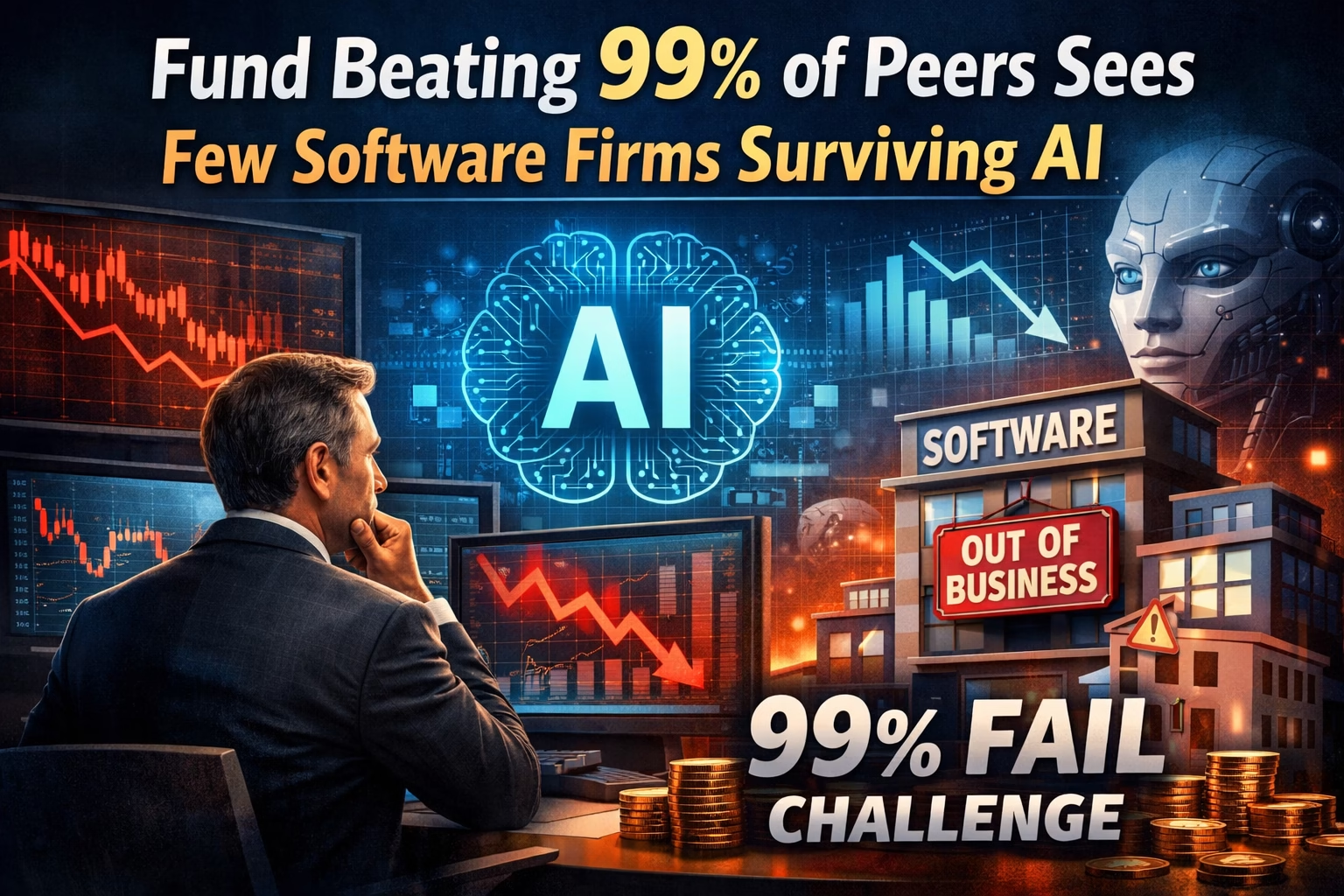
Fund Beating 99 % of Peers Says Few Software Firms Will Survive AI Disruption
In one of the most striking investor warnings of recent years, the manager of a top-performing global technology fund has declared that most traditional software companies will struggle to survive the rapid rise of artificial intelligence. This portfolio has outperformed 99 percent of its peers, a feat that has drawn attention not just for the performance itself, but for what it reveals about the future direction of technology investing and the kinds of platforms likely to win big projects in the AI era.
Nick Evans, manager of a multi-billion-dollar technology fund, explained that his strategy of moving away from conventional software stocks before the broader market reacted allowed his fund to beat nearly all rivals. According to Evans, the fundamental economics of application software—once the dominant force in corporate technology—are being disrupted by generative AI tools capable of performing many tasks traditionally handled by software products.
Why Traditional Software Is Under Pressure
For decades, software companies have thrived on subscription models and licence sales. Businesses paid for access to applications that helped them manage tasks such as payroll, customer records, document creation, and workflow coordination. These models generated reliable recurring revenue, and software stocks were widely viewed as safe, long-term investments.
That narrative is now changing. AI systems can automate increasingly complex functions, reducing the need for traditional software licences. Instead of buying a suite of software tools, companies can use smart AI platforms that learn, adapt, and streamline workflows in real time. This evolution is causing what investors call “seat compression,” where fewer paid licences are needed because AI can replace or augment human users.
Evans warns that many conventional software firms are at risk of becoming commoditised or irrelevant unless they adapt. The implication is not that all software will disappear but that only a select group of companies with agile strategies and deep AI integration will survive.
Which Platforms Are Most Likely to Win Big Projects?
A key question facing entrepreneurs and investors alike is which of the following platforms has the best chance of winning big amount projects going forward. In a world reshaped by AI, not every technology platform will have equal opportunity. Certain categories appear better positioned to capture large contracts and long-term enterprise commitments:
1. AI-Driven Workflow Platforms
These platforms do more than automate a task; they reimagine entire business processes. Companies that deliver AI solutions capable of managing end-to-end workflows—such as customer support, finance operations, supply chain monitoring, and human resources—stand to attract major enterprise spending.
2. Cloud Infrastructure and Data Platforms
Platforms providing backend data services, scalable cloud environments, and robust AI training infrastructure are likely to see sustained demand. Enterprises increasingly value systems that host and power advanced AI applications, even if they do not directly compete with traditional software.
3. Vertical AI Platforms with Deep Industry Focus
Some sectors, such as healthcare, logistics, and energy, require specialised systems that deeply embed into business operations. AI platforms tailored to these needs—particularly those that improve efficiency or reduce operational risk—are well-positioned to win large projects because their value is mission-critical.
4. Developer and AI Orchestration Platforms
Tools that help organisations build, deploy, and manage AI systems internally will see greater adoption as demand for custom AI solutions grows. These platforms empower businesses to control their AI initiatives without relying exclusively on generalised products.
Platforms that simply bolt AI onto legacy software without real transformation are less likely to attract significant enterprise budgets. This has created a kind of competitiveness where roughly 99 percent of fledgling AI software products struggle to secure meaningful market traction—a pattern some investors call the 99 percent fail challenge.
A Rising Focus on Strategic Funding
As traditional software companies face pressure, capital is shifting toward firms with clear AI-driven growth paths. Some investors and startup communities refer informally to funds like the so-called 9999 fund, representing capital pools that allocate aggressively into future-oriented technologies. These funds prioritise high-impact platforms over legacy models, betting that early support for the right technologies will yield disproportionate returns.
Online startup funding platforms like fundingpeaks com have seen renewed interest as founders seek capital for AI-centric ventures. Investors on these platforms are increasingly selective, favouring projects that demonstrate deep domain expertise, scalable technology infrastructure, and a clear path to enterprise adoption. The era of broad software licensing growth is giving way to targeted investments in platforms that can prove immediate and measurable business value.
Not All Software Is Doomed
Despite the sobering prognosis for many traditional software companies, Evans and other investors emphasise that not all software sectors are equally at risk. Highly specialised enterprise systems with deep integrations—for example, complex logistics software, mission-critical ERP systems, or platforms embedded into essential manufacturing processes—can still maintain relevance. These systems often require customised support and ongoing development that AI alone cannot easily replace.
Furthermore, software companies that embrace AI as a core component of their products, rather than a superficial add-on, may find new growth avenues. For example, applications that provide real-time analytics, automated decision support, or adaptive security features can augment human workflows in ways that competitors cannot replicate cheaply.
What This Means for Investors and Founders
For investors, the shift in software economics means rethinking long-held assumptions about growth and stability. Traditional metrics for valuing software companies—such as predictable subscription revenue and user licence growth—may become less reliable if AI adoption accelerates and reduces dependence on conventional tools. Instead, performance indicators tied to AI adoption rates, data engagement, and integration depth may become more important.
Founders, too, face strategic challenges. Those building new startups or scaling existing businesses must consider the value proposition of their platforms in an AI-centric world. Simply offering a “better version” of existing software tools is no longer enough. To win big projects, companies need to demonstrate that their platforms can leverage AI to solve hard problems, reduce operational costs, or unlock growth opportunities that legacy systems cannot deliver.
This shift has prompted a wave of innovation but also a wave of consolidation. Larger technology companies are acquiring promising AI startups, while venture funding increasingly flows to platforms with clear enterprise strategies. The result is a market where only a select group of platforms — those that harness AI effectively — will attract major contracts and long-term commitments.
The Road Ahead
The rapid evolution of AI is not a temporary trend but a structural transformation affecting every layer of technology. Many traditional software vendors will need to adapt quickly or risk losing relevance. At the same time, new platforms with deep AI integration, strong enterprise alignment, and scalable technology stacks have an opportunity to dominate the next generation of enterprise spending.
Investors who understand this shift — and who back platforms capable of winning substantial projects — may outperform competitors just as the fund beating 99 percent of its peers has done. Meanwhile, companies that cling rigidly to old subscription-based models risk becoming relics of a bygone era.
Only time will tell which platforms truly define the future of software in the AI age. But one thing is clear: the winners will be those that rethink, reinvent, and embrace the full potential of artificial intelligence.
❓ Frequently Asked Questions (FAQs)
1. Why does the fund beating 99% of peers believe most software firms won’t survive AI?
The fund manager argues that artificial intelligence is replacing many traditional software functions. AI tools can automate workflows, generate content, analyze data, and even write code. This reduces the need for multiple software subscriptions, threatening the revenue models of conventional SaaS companies.
2. What is meant by the “99 percent fail challenge” in AI startups?
The “99 percent fail challenge” refers to the reality that most AI startups struggle to achieve long-term profitability or large enterprise adoption. While many companies enter the AI market, only a small percentage succeed in winning major projects or securing sustainable funding.
3. Which of the following platform has the best chance of winning big amount projects?
Platforms most likely to win large enterprise projects are:
- AI-driven workflow automation platforms
- Cloud infrastructure and data platforms
- Industry-specific (vertical) AI solutions
- AI development and orchestration tools
These platforms offer scalable, enterprise-level value rather than simple AI add-ons.
Choose the Right AI Coding Tool for Your Projects
Don’t let confusion slow you down. Our comparison of Claude Code and Cursor shows you exactly when and why to use each tool. Enhance your coding efficiency and explore more AI-driven insights on RojrzTech now!