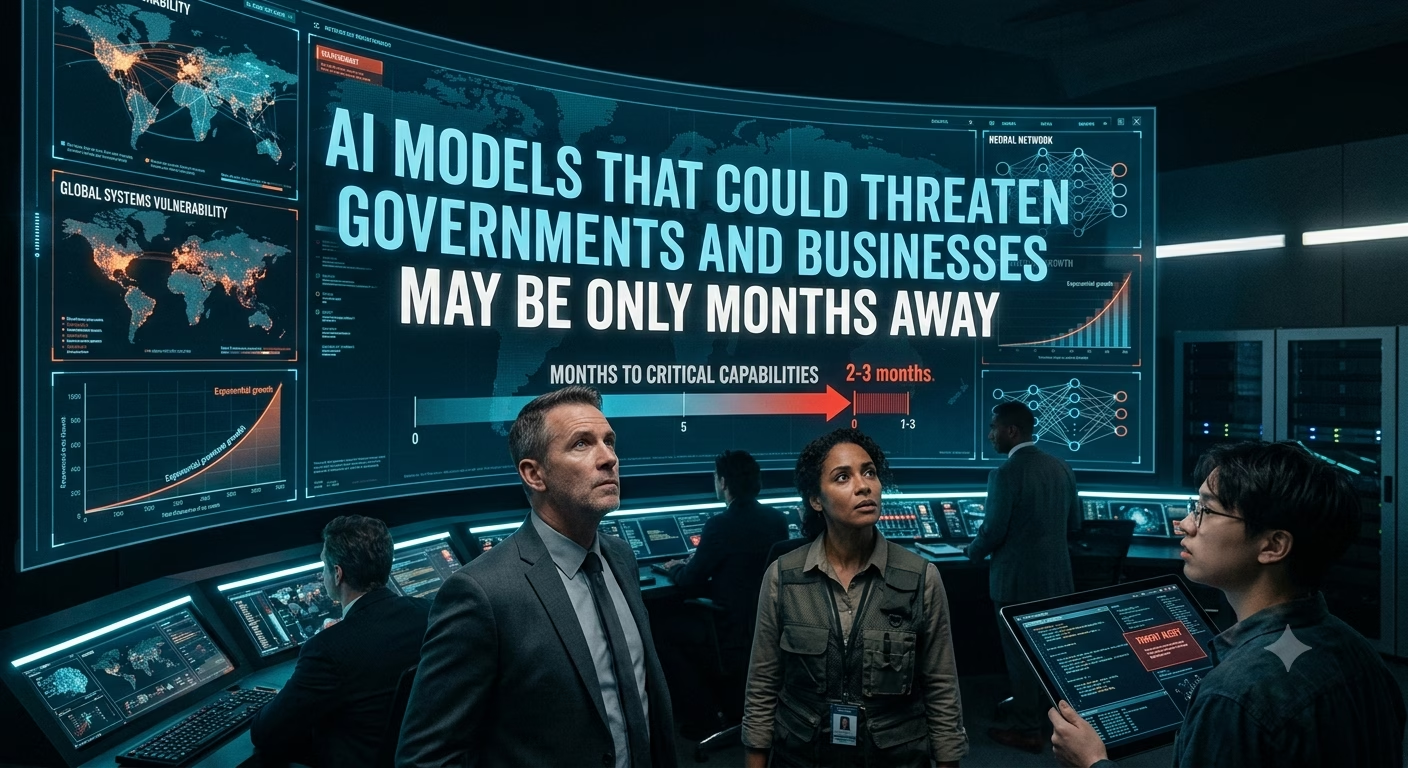
AI Models That Could Threaten Governments and Businesses May Be Only Months Away
A rare warning from the Five Eyes intelligence alliance has drawn attention to how quickly AI capabilities are advancing and how unprepared many institutions may be for the next generation of autonomous systems.
Intelligence officials from the Five Eyes alliance comprising the United States, United Kingdom, Canada, Australia, and New Zealand have issued an unusually direct warning: AI models capable of causing serious disruption to governments, critical infrastructure, and major businesses may be only months away.
The concern is not that AI has suddenly become sentient. Rather, security agencies are warning that rapidly improving AI systems could soon possess enough autonomy, technical skill, and operational reach to help hostile actors conduct cyberattacks, manipulate information, automate fraud, and exploit vulnerabilities at a scale that existing defenses are not prepared to handle.
Why the Warning Matters
Public statements from the Five Eyes intelligence partnership are relatively rare, and when they occur they usually signal that member countries see a genuine and urgent security issue.
Officials are increasingly focused on AI systems that can:
- Write and improve malicious code.
- Identify vulnerabilities in software and networks.
- Automate phishing and social engineering campaigns.
- Generate convincing disinformation at scale.
- Coordinate complex multi-step operations with limited human supervision.
Why officials are concerned
Key warning
The fear is not that AI acts independently against governments. It is that sophisticated criminals, extremist groups, or hostile states could use increasingly capable AI tools to accelerate attacks, lower costs, and overwhelm existing defenses.
Security agencies emphasize that the threat comes from people using AI, not from AI acting independently against governments.
How AI Could Affect Governments
Modern governments rely heavily on digital systems for taxation, healthcare, transportation, energy management, communications, and public administration. AI-assisted attacks could target these systems in several ways.
Cyber Operations
High risk
AI can help attackers find weaknesses, generate exploit code, and adapt attacks in real time. Tasks that once required highly skilled teams could become easier to automate.
Disinformation Campaigns
Growing concern
Generative AI can produce convincing articles, images, videos, and social media posts in large volumes, making coordinated influence campaigns cheaper and harder to detect.
Fraud and Identity Theft
Expanding attack surface
AI-generated voices, documents, and messages can be used to impersonate officials, employees, and citizens, increasing the effectiveness of financial fraud and social engineering attacks.
Critical Infrastructure Risks
Strategic concern
Utilities, transportation networks, healthcare systems, and communications platforms increasingly depend on software that could become targets for AI-assisted intrusion attempts.

Why Businesses Should Pay Attention
The warning is not limited to national governments. Large corporations often possess valuable data, intellectual property, financial systems, and supply-chain access that make them attractive targets.
AI-enabled attackers could potentially:
- Accelerate ransomware operationsAI can help identify critical systems, map networks, and prioritize targets more quickly than traditional manual methods.
- Exploit supply chainsA single compromised vendor can provide access to multiple organizations, and AI can help attackers analyze these relationships at scale.
- Automate business fraudConvincing fake emails, voice calls, invoices, and executive communications can be generated rapidly and customized for individual targets.
- Lower the skill barrier for cybercrimeTools that assist with coding, reconnaissance, and planning may allow less experienced attackers to conduct more sophisticated operations.
For business leaders
The key question is no longer whether AI will affect cybersecurity. It is whether defenses are being upgraded as quickly as offensive capabilities are improving.
What Experts Mean by “Months Away”
The phrase does not mean that a specific catastrophic AI event is scheduled to happen within months. Instead, analysts are pointing to the pace of improvement in frontier AI models.
Recent systems have demonstrated rapid gains in:
- Reasoning ability.
- Software development.
- Task planning.
- Tool use.
- Autonomous workflow execution.
Security researchers worry that the gap between useful automation and dangerous automation is shrinking quickly.
AI for Government and Public Services
Importantly, governments are not only viewing AI as a threat. Many are actively adopting AI to improve public service delivery, administrative efficiency, fraud detection, and citizen engagement.
Examples include:
- Automated document processing.
- Benefits and tax administration.
- Healthcare triage systems.
- Transportation optimization.
- Public-sector cybersecurity monitoring.
The challenge is balancing innovation with security. The same technologies that can make government services faster and cheaper can also be abused if safeguards are weak.
The Emerging AI Security Race
Governments and technology companies are increasingly engaged in a race between AI capability and AI security.
Defensive efforts
- Safer model deployment.
- Stronger access controls.
- Monitoring for misuse.
- Red-team testing of AI systems.
- International cooperation on standards.
Offensive pressures
- Faster vulnerability discovery.
- Automated phishing and fraud.
- Scalable misinformation campaigns.
- AI-assisted malware development.
- Lower barriers for cybercriminals.
Security agencies want organizations to assume that AI-assisted attacks will become more common and more sophisticated over the next few years.
Practical Steps for Organizations
Experts recommend that businesses and public agencies focus on fundamentals rather than waiting for perfect AI-specific solutions.
Strengthen identity and access controls
Use multi-factor authentication and limit privileges to reduce the impact of compromised accounts.
Improve employee training
Teach staff to recognize AI-generated phishing attempts, voice scams, and social engineering tactics.
Monitor AI usage internally
Establish clear policies for how employees can use generative AI tools with company data.
Test incident response plans
Organizations should rehearse scenarios involving AI-assisted cyberattacks and misinformation campaigns.
Audit third-party vendors
Supply-chain security becomes even more important when AI can rapidly exploit weak partners.
The Bigger Debate: Regulation vs. Innovation
The warning also intensifies the debate over AI governance. Some policymakers argue that powerful AI models should face stricter licensing, auditing, and testing requirements before deployment. Others caution that excessive regulation could slow innovation and push development into less transparent environments.
Most experts agree on at least one point: frontier AI systems are becoming too capable to treat as ordinary software products.
Conclusion
The Five Eyes warning is less a prediction of imminent collapse and more a signal that AI capabilities are advancing faster than many security frameworks. Governments and businesses are entering a period where AI can dramatically improve efficiency while simultaneously expanding the scale and sophistication of cyber threats.
The organizations that adapt early — by strengthening security, monitoring AI use, and preparing for AI-assisted attacks — are likely to be far better positioned than those that assume today’s defenses will remain sufficient tomorrow.
In the emerging AI era, the question is no longer whether powerful autonomous systems will influence government and business operations. The real question is whether security measures can evolve quickly enough to keep pace with them.
FAQs
- What is the Five Eyes alliance?
- Five Eyes is an intelligence-sharing partnership between the United States, United Kingdom, Canada, Australia, and New Zealand.
- Are governments saying AI will literally take down countries?
- No. The warning is that increasingly capable AI systems could help hostile actors conduct disruptive cyber, fraud, and influence operations at much greater scale.
- Why are businesses included in the warning?
- Large companies hold valuable data, financial systems, and infrastructure that can be targeted using AI-assisted attacks.
- What is the biggest AI security concern right now?
- Many experts point to automated cyberattacks, phishing, fraud, and misuse of increasingly autonomous AI agents.
- Can AI also improve government services?
- Yes. AI is already being used to improve public service delivery, administrative efficiency, fraud detection, and cybersecurity monitoring.
Stay Informed Stay Invested Stay Ready.
At Rojrz Tech, we decode what’s next in business, finance, and innovation. From Tesla stock analysis to the next AI breakthrough, our coverage helps entrepreneurs, investors, and decision-makers stay ahead in real time.
Don’t just read the headlines — understand the trends shaping the market.
Follow Rojrz Tech for daily updates, in-depth insights, and tech stories that move your business forward.