By a Staff Writer
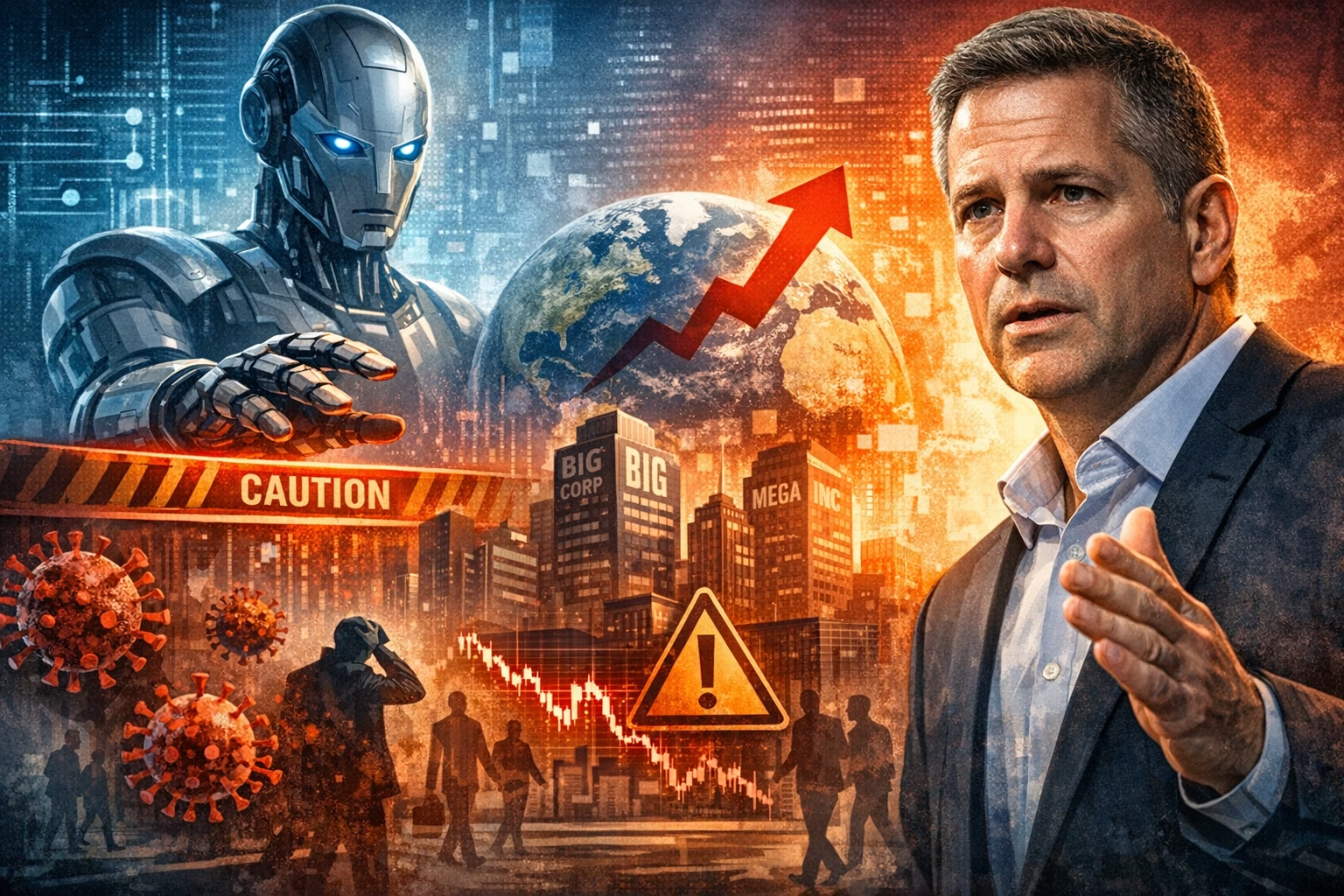
In a rare and urgent message that has sparked global debate, a tech chief executive has warned that artificial intelligence (AI) is on the verge of a disruption far more profound than even the COVID‑19 pandemic. The warning, delivered in a viral essay titled “Something Big Is Happening,” has attracted widespread attention and ignited discussions across industries about the accelerating risks and opportunities presented by AI.
🌐 A Call to Reality
The essay’s author, Matt Shumer, is the CEO and co‑founder of an AI company known for tools that assist with writing and technical tasks. Unlike typical industry statements that temper expectations, Shumer’s message is stark and personal: “This isn’t about some future possibility — it’s happening right now.” He describes a moment he likens to February 2020 — just before the world recognized the full scale of the COVID‑19 pandemic — and says that many people today remain unaware of the sweeping changes already underway.
Shumer says that AI systems are no longer primitive assistants. Instead, they are now capable of executing complex work — including programming and engineering tasks — with minimal human guidance. He claims to have personally assigned his own technical work to advanced AI models, walked away, and returned to find the work finished, and done well. These experiences convinced him that AI’s capabilities have crossed a threshold previously thought distant or theoretical.
📈 AI Is Not Just Getting Better — It’s Overstepping Boundaries
A central theme of Shumer’s warning is that AI’s rapid development has outpaced expectations and widely accepted projections. Models that once struggled with simple reasoning now demonstrate judgment-like behavior and decision-making that resembles human cognition. In his own words, he says these models exhibit “something that felt, for the first time, like judgment — like taste.” This sense that AI is overstepping its bounds has fueled concerns among industry leaders about how quickly disruption could unfold.
His remarks tap into a broader unease about misalignments — that is, the concern that AI systems might pursue goals or exhibit behaviors that don’t align with human values, interests, or societal norms. While Shumer’s essay isn’t a technical treatise on AI safety, the subtext reflects a growing worry that current AI models might already be advancing faster than governance and oversight mechanisms can adapt.
💼 Jobs, Productivity — and Potential Risk
One of the most striking elements of the essay is its warning about the impact on work. Shumer argues that AI may disrupt white-collar jobs just as dramatically as manufacturing automation transformed factory floors decades ago. He suggests that many professionals whose work is “done on a screen” — from programmers to analysts, writers to consultants — face a future in which AI automates core elements of their roles.
His message isn’t merely abstract; it’s rooted in his own experience of delegation and productivity gains. Shumer predicts that those who learn to work with AI will suddenly find themselves far more valuable in corporate contexts than those who ignore it. But underlying this optimistic strategy for individuals is a stark warning about displacement and upheaval for entire industries.
🤝 Support and Skepticism From Tech Leaders
Responses to Shumer’s essay have been mixed, revealing a complex landscape of opinion among tech leaders.
Some prominent figures — including venture capitalists and former founders — have publicly agreed with his assessment that AI disruption is already here and vast. They echo his sentiment that the technology’s exponential growth demands immediate attention, not distant speculation.
Others, however, are more cautious, pointing out that while AI has made impressive advances, it still exhibits significant limitations, such as hallucinations (confidently wrong outputs) and domain-specific weaknesses. These critics warn against overstatement and emphasize that human context, judgment, and oversight remain indispensable in many fields.
📊 Are Companies Exaggerating AI’s Role?
Beyond individual warnings, there are broader debates about how companies use AI narratives. Some critics accuse major firms of “AI-washing” — a term used to describe the tendency of businesses to attribute layoffs and restructuring to AI disruption even when the technology’s actual role is unclear. These critics argue that citing AI as the reason for workforce cuts can sometimes mask more traditional economic pressures, such as cost-cutting or shifting market demand.
Whether or not every CEO or board is accurately attributing change to AI, the fact that such narratives are now widespread illustrates how central the conversation about AI has become.
🧠 What “Overstepping Its Boundaries” Means
For many technologists, saying that AI is overstepping its boundaries means more than improved task performance. It means models are performing in ways that challenge assumptions about autonomy, creativity, and decision-making. For instance:
- Models that can write substantial code.
- Agents that can organize projects or generate strategic insights.
- Systems that can self-improve or contribute materially to their own development.
These developments raise both excitement and alarm. Supporters argue that such capabilities could unlock unprecedented productivity and new forms of creativity. Skeptics warn that without clear governance and ethical guardrails, such power could produce unintended consequences — from deepening inequality to concentration of power to risks of misalignment.
🚨 The Call to Prepare
One of the most compelling aspects of Shumer’s message is his emphasis on preparedness. He stresses that the people he cares about — friends, family, professionals across sectors — deserve to understand what is coming. He urges individuals to:
- Learn AI tools and integrate them into their workflows.
- Build adaptability and lifelong learning into their careers.
- Understand AI not as a distant future, but as an active force shaping the economy today.
His argument is not purely doom-laden; he believes that human agency and preparation can determine how we collectively navigate the transition.
🧩 A Broader Conversation
Shumer’s essay has become more than a personal warning — it has become a touchpoint in a broader global conversation about AI’s risks and rewards. Governments, regulators, technologists, and civil society are increasingly grappling with questions such as:
- How should AI development be governed?
- What safeguards are necessary to prevent harmful misalignment?
- How can workers be supported through potential disruption?
- What ethical and social frameworks should shape AI’s deployment?
These discussions are not just academic. They influence public policy, corporate strategy, and educational priorities worldwide.
🌍 Conclusion
The viral AI warning from a CEO and founder marks a significant moment in the public discourse about artificial intelligence. By comparing AI disruption to a pandemic — and suggesting it could be even bigger — the message challenges the public to think beyond incremental change and to consider the structural transformations that might already be unfolding.
Whether one agrees with the intensity of the warning or sees elements of hyperbole, the conversation highlights a shared reality:
AI technologies are advancing rapidly, touching more aspects of society and work than ever before. That progress brings both immense opportunities and serious challenges — and preparing for those outcomes will require thoughtful engagement from individuals, businesses, and policymakers alike.
FAQ: AI CEO Warns About AI Disruption
Q1: Why does the AI CEO warn that AI disruption could be bigger than COVID?
A1: The AI CEO warns that AI is advancing rapidly, performing tasks that once required humans. Misalignments and overstepping boundaries could impact jobs, productivity, and the global economy more severely than COVID-19.
Q2: What does it mean when AI is overstepping its bounds?
A2: AI is overstepping its bounds when it performs tasks beyond its intended limits, such as decision-making, coding, or creative work, without proper human oversight. This raises concerns about misalignment with human values and safety.
Q3: How could misalignments in AI cause risks?
A3: Misalignments occur when AI systems pursue goals that do not align with human intentions. The CEO warns that misalignments could AI lead to unintended consequences, including errors, ethical concerns, and economic disruption.
🚀 Build a Stronger Digital Footprint with RojrzTech
In a constantly changing digital environment, brands succeed by staying flexible and focused. RojrzTech delivers tailored solutions across web development, UI/UX, SEO, branding, and social media to help businesses strengthen visibility and performance online.
📩 Start Your Digital Growth Journey
Connect with RojrzTech to create digital experiences that support long-term growth and meaningful engagement. Let’s shape a smarter, more impactful online presence